Travel
COVID-19 Travel Advisories
Current global COVID-19 activity levels, regional risk assessments, and evidence-based guidance for travelers — sourced from the WHO, CDC, and official health authorities.
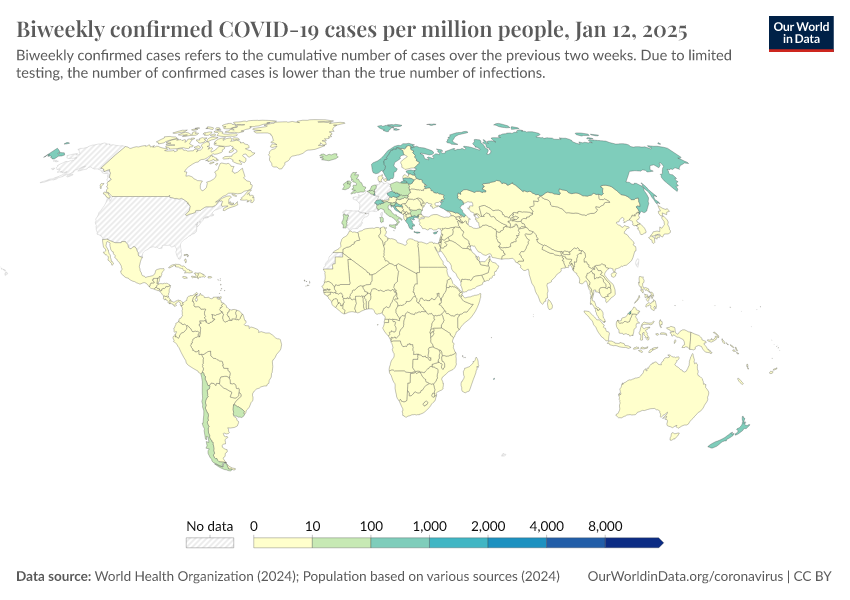
Live Global Activity Map
Global COVID-19 biweekly cases per million. Static map snapshot is shown for reliability, with a direct link to the live interactive explorer.
Regional Risk Overview
WHO regional activity levels based on available reporting and surveillance (reviewed July 2026).
Americas
Cases (last 28 days): See WHO dashboard
Major reporting region. Mid-2026 U.S. data showed NB.1.8.1 becoming a leading lineage with rising ED visits in some periods. Always check local CDC and state data before travel.
Countries include
United States, Canada, Brazil, Mexico, Argentina
Europe
Cases (last 28 days): See WHO dashboard
Activity generally moderate with heterogeneous country patterns. JN.1-descendant lineages including XFG and NB.1.8.1 continue to circulate. Hospitalizations remain low relative to peak pandemic years.
Countries include
France, Germany, Italy, Spain, United Kingdom
South-East Asia
Cases (last 28 days): See WHO dashboard
Reported activity remains relatively low in many countries after earlier 2025 waves. Testing and reporting intensity vary by country.
Countries include
India, Thailand, Indonesia, Bangladesh, Nepal
Africa
Cases (last 28 days): Limited reporting
Reported case counts are low. Testing infrastructure varies significantly; actual burden may be underreported. Follow national ministry guidance.
Countries include
South Africa, Nigeria, Kenya, Ethiopia, Egypt
Eastern Mediterranean
Cases (last 28 days): Limited reporting
Reporting has been inconsistent across the region. Use national health authority pages and the WHO dashboard for the latest available data.
Countries include
Saudi Arabia, UAE, Egypt, Iran, Pakistan
Western Pacific
Cases (last 28 days): See WHO dashboard
NB.1.8.1 has been predominant in parts of this region. PQ.16.1.1 (a NB.1.8.1 descendant) was designated a WHO Variant Under Monitoring in July 2026, with many sequences from Singapore and the Western Pacific.
Countries include
China, Japan, South Korea, Australia, Philippines, Singapore
Currently Circulating Variants
Approximate global sequence prevalence for the period ending about 21 June 2026 (WHO). PQ.16.1.1 was newly designated a Variant Under Monitoring on 27 July 2026. No elevated severity signal has been reported for current VUMs relative to one another.
COVID-19 Travel Advisories
Current advisory status from official sources, reviewed July 2026.
CDC: COVID treated as endemic respiratory virus
COVID-19 is managed as an endemic respiratory pathogen. Always check the full CDC Travel Health Notices list before travel — other diseases (e.g. chikungunya, Ebola) may have active notices even when COVID-specific notices do not.
WHO: No PHEIC; ongoing surveillance
The WHO ended the COVID-19 Public Health Emergency of International Concern in May 2023. Global risk assessments in 2026 describe moderate ongoing risk with low hospitalization and death relative to peak years, continued variant evolution, and incomplete sequencing in many countries.
WHO COVID-19 DashboardIncreased caution for high-risk travelers
Older adults, immunocompromised people, and those with underlying conditions remain at higher risk of severe COVID-19. Take enhanced precautions regardless of destination risk level, and discuss antiviral access with your clinician before travel.
Before You Travel
Essential steps to take before departing — especially if traveling to regions with moderate or elevated activity.
Check destination-specific requirements
Visit the CDC Travelers' Health destination pages and review any entry requirements. Some countries still require proof of vaccination or a negative test.
CDC Destination List →Get up to date on COVID-19 vaccines
Ensure you have received the latest recommended COVID-19 vaccine. 2025–2026 formulations remain available; 2026–2027 XFG formula is planned for fall 2026. Vaccination reduces risk of severe illness.
Stay Up to Date →Consult your doctor if you are high-risk
Older adults (65+), immunocompromised individuals, and those with underlying conditions should discuss travel plans with their healthcare provider.
High-Risk Conditions →Pack COVID tests and essential supplies
Bring rapid antigen tests, masks (N95/KN95), and any prescription medications. Ensure you have enough medication for the duration of your trip plus extra.
Testing Guidance →Get travel health insurance
Ensure your travel insurance covers COVID-19-related medical care, evacuation, and trip cancellations. Standard policies may exclude pandemic-related claims.
Travel Insurance Info →Review the full CDC Travel Health Notices
Check for any active Travel Health Notices for your destination — these cover COVID-19 and other health risks (chikungunya, dengue, Ebola, measles, etc.).
Current Travel Notices →While Traveling
Precautions to reduce your risk of COVID-19 exposure during your trip.
Wear a well-fitted mask in crowded spaces
In airports, on planes, trains, and in busy indoor areas, an N95 or KN95 mask provides strong protection, especially in regions with higher activity.
Practice good hygiene constantly
Wash hands frequently with soap and water for at least 20 seconds. Use hand sanitizer (≥60% alcohol) when handwashing isn't available.
Avoid crowded poorly ventilated spaces
Choose outdoor dining, open-air venues, and well-ventilated spaces when possible. COVID-19 spreads most efficiently in indoor settings with poor air circulation.
Monitor local health authority updates
Conditions can change quickly. Follow local health ministry announcements and check the WHO COVID-19 Dashboard for real-time regional activity.
Know how to access healthcare abroad
Before traveling, locate the nearest hospital or clinic to your destination. Keep your insurance card, emergency contacts, and your country's embassy number accessible.
Test and isolate if you feel symptomatic
If you develop symptoms (fever, cough, sore throat, loss of taste/smell), use a rapid antigen test immediately and follow local isolation rules. Do not board flights while sick.
After You Return
Post-travel steps regardless of where you traveled.
Monitor for symptoms for 10 days
Watch for COVID-19 symptoms for 10 days after returning. Common symptoms include fever, cough, shortness of breath, sore throat, and loss of taste or smell.
Test if symptomatic
Take a rapid antigen test if you develop any symptoms. A PCR test is more sensitive for travelers who have been in higher-activity regions.
Notify close contacts if you test positive
If you test positive after returning, inform people you were in close contact with during your trip so they can monitor and test themselves.
Seek treatment promptly
Antiviral treatments (like Paxlovid) are most effective when started within 5 days of symptoms. Contact your healthcare provider immediately upon a positive test.
Live Data & Official Sources
Check these official sources for the most current travel health information before and during your trip.
WHO COVID-19 Dashboard
Real-time global cases, deaths, hospitalizations, variants, and vaccination data by country and WHO region.
Visit source →CDC Travel Health Notices
Level 1–4 travel health notices for COVID-19 and other infectious diseases. Updated as outbreaks occur.
Visit source →CDC Travelers' Health — Destinations
Country-by-country health information, required vaccines, health risks, and safety tips for international travelers.
Visit source →U.S. State Dept. Travel Advisories
Level 1–4 safety advisories for every country, covering security, natural disasters, and health risks including COVID.
Visit source →WHO Circulation Dashboard
Detailed SARS-CoV-2 test positivity and wastewater surveillance data by country and subregion.
Visit source →PAHO: COVID-19 Americas Updates
Pan American Health Organization weekly COVID-19 updates for the Western Hemisphere.
Visit source →